

Human Resource Management
Supporting the SDGs Goals


Management Approach
The Company drives its human resource management under the 100x Happiness strategy with the Best Employer approach, together with adherence to the corporate values of “vr bcp”, under the principles of fair management and non-discrimination, while reviewing and enhancing employee development systems to support business transformation, by implementing operations in accordance with the following 4 strategic pillars.

The Great Place to Work
To elevate the organization to be a workplace of pride, through employer branding, proactive recruitment, and the provision of fair and competitive compensation and benefits.

Unlock Future Potential
To develop the capabilities of employees and newgeneration leaders to be ready for future business directions, through a competency framework, upskilling and reskilling, and a systematic talent development system.

Synergy to be the Best
To enhance the role of human resource management to become a strategic partner, and to create a unified people management standard across the organization, by utilising HR Tech and AI to increase efficiency and support decision-making.

RUN Capabilities
To drive organizational competencies and culture into practical outcomes, through coaching, developmental conversations, the promotion of collaboration, and the cultivation of the “vr bcp” values.
1. Workforce Planning and Recruitment

Provided scholarships at the bachelor’s and master’s degree levels in STEM fields.
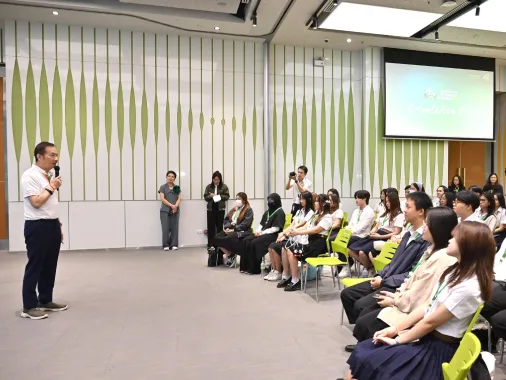
Implemented the Bangchak Talent Internship Program 2025
With more than 1,000 applicants, 125 interns selected, and opportunities to participate in the Bangchak Young Greenovator program to design and present solutions based on real business case studies of the Group.

Established the Management Trainee (MT) program
To develop high-potential new-generation talent through real business assignments, providing development in both theoretical and practical aspects, together with guidance from executives.

The use of AI
To enhance recruitment efficiency resulted in a reduction in screening and shortlisting time by more than 70%, a decrease in workload (man-days) by 84%, and cost savings of 85%.
Workforce Planning and Recruitment 2025


2. Employee Development through Bangchak Learning Academy
Development of high-potential employees is carried out through four core programs:
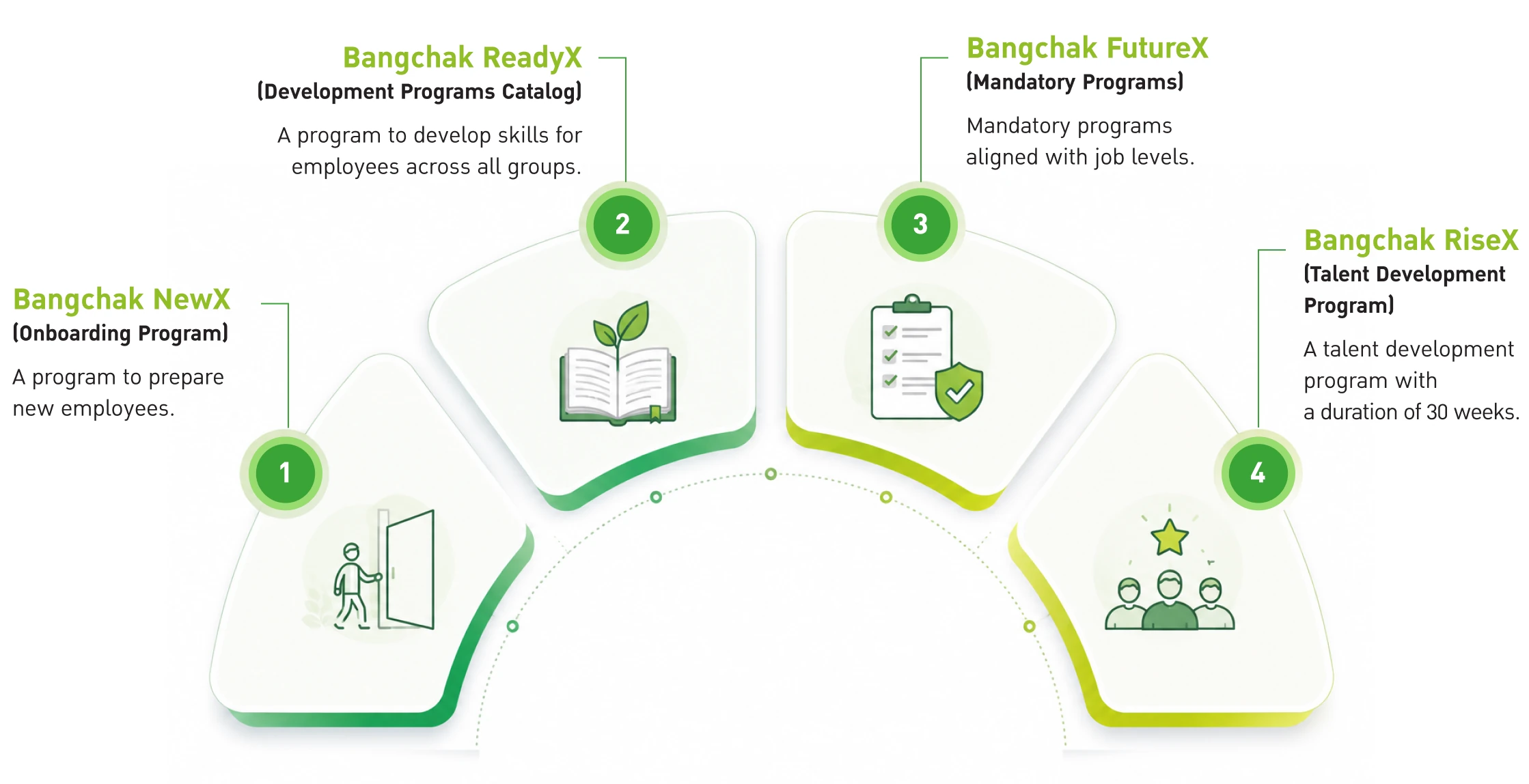
Employee Development 2025


3. Performance Evaluation and Compensation Management
Compensation Management
is conducted based on comprehensive analyses, including market benchmarking and living wage analysis.
Performance Management
is carried out to transparently determine individual compensation adjustments through the annual performance management system, which consists of:
Key Performance Indicators (KPIs)
- Measures work achievements against defined targets as the primary evaluation tool.
- Under the Balanced Scorecard framework (Kaplan & Norton), covering 4 perspectives: Financial, Customer, Internal Process, and Learning & Growth.
- Covers 3 levels: organizational, business unit, and individual.
Competency & Behavior
- Assesses behaviors aligned with the organization’s core values.
Multidimensional Performance Appraisal
Enhances the comprehensiveness of performance data through multiple dimensions, including:
- Potential Assessment: Conducted for employees at various levels by supervisors, peers, and relevant cross-functional stakeholders (as appropriate).
- Team-based Appraisal: Emphasizes teamwork and collective outcomes, promoting shared accountability and team-based performance.
- Agile Conversations: Focuses on continuous performance follow-up and feedback exchange through the One-on-One program at least 4 times per year, supporting quality dialogue between supervisors and employees (with 98% employee participation across the organization). Informal feedback is also encouraged at any time through the vr bcp Point system, applying the STAR principle (Situation–Task–Action–Result).

4. Employee Engagement Management
Focuses on fostering “4 Dimensions of Happiness” as follows:
Happiness Dimension 1
Happy Stay Living and Working with Peace of Mind
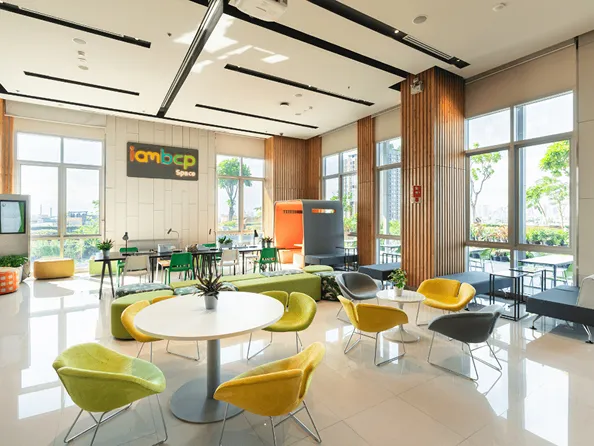
Develops and enhances office spaces to support a conducive working environment.
Happiness Dimension 2
Happy DNA Development under “vr bcp”
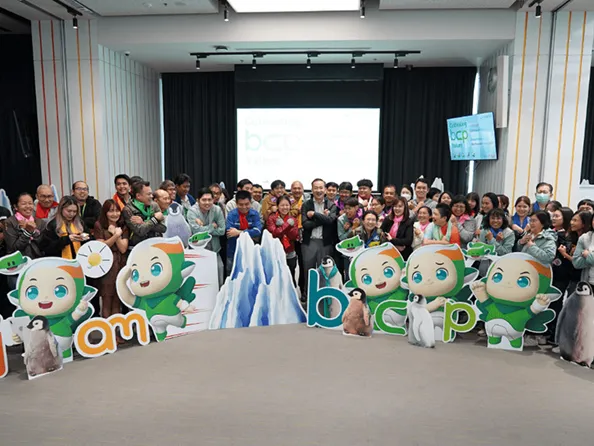
Promotes ownership and understanding of the “vr bcp” core values through the Core Value Journey plan, with behavioral communication via vr bcp Story, the core values handbook, and workshop activities, as well as the establishment of Culture KPIs.
Happiness Dimension 3
Happy Me Being Cared for with Well-Being
- Promotes work–life balance and provides health and holistic well-being benefits, including medical care, health insurance, and proactive healthcare.
- Provides employee assistance benefits such as provident fund/gratuity, housing loan benefits, education support for employees’ children, funeral assistance, disaster relief support, and long-service awards.

Happiness Dimension 4
Happy Heart Caring with Heart
Promotes employee communication and engagement through key mechanisms, including BCP Town Hall, CEO Box (an anonymous feedback channel with direct responses from the CEO), and relationship-building activities between senior executives and employees throughout the year.